Showing posts with label Rwanda & TRO. Show all posts

Friday, 16 December 2016

2016/17 Trip: Rwanda


Monica joined Brenda, Peter and the Barkley family in Rwanda
Here they are pictured at one of the Genocide memorial sites. 

Brenda first visited Rwanda and Tanzania in 2006 on a W.V. trip.  Before leaving Canada all the volunteers were supposed to get 2 children sponsored - Brenda found sponsors for 18 children! In the following three years Brenda and One Person signed up over 60 sponsors for W.V., and Brenda, and volunteer teams, went back to both countries each year to visit the children. 

In 2007 we established a permanent connection with Kahama in rural Tanzania, where most of the sponsor children were from but still visit with the many friends that Brenda has made over the years. Our first shipping container went to Muhanga, Rwanda and we have given support to a school and clinics in the area. 

Click the 'Rwanda' label on the right to find out more about our friends and activities here. 

Like us on facebook to see all the latest pictures.

Sunday, 14 June 2015

2015 Volunteer Trip: Muhanga, Rwanda

Terimbere-Rwanda Organization

Brenda and Denise Ingabire from TRO  cutting the ribbon for the new sewing-room
We also, in a small way, support the Terimbere-Rwanda Organization (TRO) in Muhanga Rwanda.

We have provided some funding for the TRO Women’s Cooperative.  These women have led harsh lives; the majority of girls and women who survived the 1994 genocide were victims of sexual violence or were profoundly affected by it.  

Participation in the TRO Women’s Cooperative begins with extensive counselling and leads to income generating projects such as a pig cooperative and a sewing cooperative. We have given and passed on donations to purchase pigs and have shipped sewing machines. 

We have also donated books and classroom supplies to the Amizero Academy, a relatively new preschool/kindergarten. The plan is that the school will eventually go up to the 8th grade. 

Resources are still limited but the children learn, play and receive nutrition.  The Academy is focused on helping vulnerable children, and the TRO founder, Costa Ndayisabye  ensures that the majority of students are girls.  
Ron and Brenda with the Women's Sewing Cooperative
Brenda at the Amizero Academy in 2013
Black & Whilte Photo Credits Soling Photography


Go to the Rwanda & TRO label on the right 
for more stories and pictures

www.theonepersonproject.org


Like us on facebook to see all the latest pictures 


Sunday, 7 October 2012

2012 Trip: Rwanda/ Muhanga/ Evariste and his family share their food with us


The  brick making volunteers were invited inside to have a late lunch, provided by Evariste and his wife (pictured by the doorway) to thank us for our help.  Lunch was cassava (a root vegetable) and beans.

Like most families in rural Rwanda, Evarist and his wife barely have enough food to feed themselves but they made sure that we were looked after. Brenda and previous volunteer teams have experienced this extraordinary generosity time and time again when visiting families in Rwanda and Tanzania.

Costa and members of another volunteer group -  
Groundwork Opportunities.

The family are part of a supportive HIV/AIDS co-operative set up by the NGO Costa is involved with, the Terimbere Rwanda Organization. TRO provides counselling and covers medical expenses for the family. AIDS is particularly prevalent in Rwanda as men infected with AIDS used rape as a deliberate weapon of war in the 1994 genocide.
We were joined by other members of the HIV/AIDS cooperative. Note the Ironman Penticton donated shirts!
Erin and Evariste's daughter Pamela
Pamela, who was three months old at this time, is not HIV positive.  
I believe that this must be due to the medication that prevents mother to child transmission
 (PMTCT)  but I will find out for sure and update the blog.

Acting as interpreter, Costa told us Evariste's story and explained the benefits of the HIV/AIDS support group. They have a pig co-operative, and thanks to your donations we were able to contribute to it on previous trips.  


Costa spoke to one of the group, an emaciated woman named Epiphany, asking for her permission to tell us her story. Epiphany was widowed and turned to prostitution in order to earn money to feed her children. She felt great guilt at knowingly passing on the infection, but having lost two of her children she did not want the remaining three to starve. Costa told us that Epiphany had been to many counselling sessions before she talked about her actions but once she did she was able to begin to heal mentally and in spirit, and the opportunity to be a part of the pig co-operative meant that she no longer had to resort to prostitution. 


It was at this point that Brenda told Costa that we were passing on donations of US$300 for the pig co-op. Costa turned to one of the older ladies and spoke to her, she clapped her hands and cried out, as did the rest of the group. Costa turned to us and said that this lady was in very poor health and was exhausted from having to walk to the market each day to sell homemade beer for little or no profit, and he had just told her "No more market. Now you can stay and help look after the new pigs."

I cried.

Friday, 5 October 2012

2012 Trip: Rwanda/ Muhanga/ Making bricks for Evariste's home

www.theonepersonproject.org 

Costa


Brenda met Costa on the first One Person trip (2008). His parents fled a Tutsis' massacre in 1959 and Costa was brought up in Burundi and the Democratic Republic of Congo. His wife, Bernadette, saw her parents and siblings killed in the 1994 genocide and survived by hiding in the ceiling of a neighbor’s home. Costa was a member of the Rebel Resistance Army that helped to overthrow the Hutu regime and he has been imprisoned three times. He documents his extraordinary life in his book The Work That Brings Peace In Me.

Costa is committed to healing himself, his family and his homeland, he travels the world promoting peace and reconciliation, and has visited with us in British Columbia. He now lives and studies in Maine, USA.

Costa is part of TRO (Terimbere Rwanda Organization, formally known as GO Rwanda.) the organization that received our first shipping container. TRO works in the Muhunga region to implement a genocide reconciliation project, which supports genocide survivors through community reconciliation and rehabilitation programs. Perpetrators also undergo rehabilitation and receive counselling before they are paired with a survivor to build homes for vulnerable families.

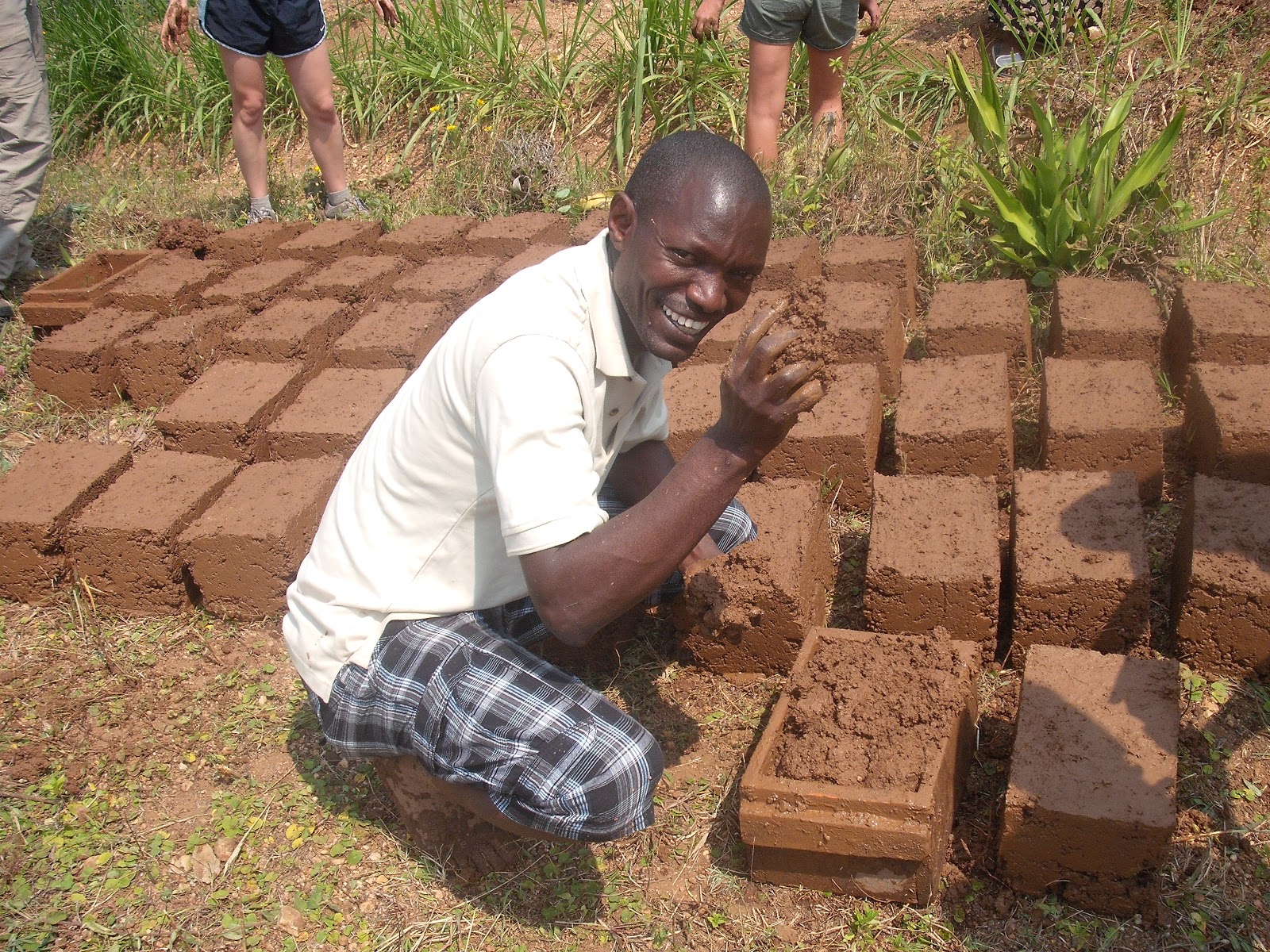
In a previous visit Brenda and a team of volunteers had helped to make bricks for one house, and now our team had the opportunity to do the same.

Brenda, One Person President and co-founder
Rwanda is called The Land of a Thousand Hills, and I'm sure that we hiked most of them on this trip!
Mary wrote about the brick making day in her blog on Planet Ranger:

"Today we hopped back on a bus to Muhanga and then walked down the side of a mountain to a house where we were invited to make mud bricks to help the family that needed them. Since we are volunteers we made around 150 bricks for free, the family was very thankful because when they pay someone to make the bricks it costs 25 RWF per brick. 150 bricks isn’t a lot, and when I roughly counted the bricks of the houses around us, I figured that we probably only made enough bricks for a quarter of a quarter of the walls. But helping the family save around 3750 RWF was a good feeling since they could now use that money to buy a goat or something else for the house.

The bricks are literally made out of dirt and water. They start by pouring water onto the dirt and then they use their feet to squish the water around, making the ground wet enough for them to throw it into a square mold for the bricks. The men making the mud held tools that looked like bent shovels to pound into the ground to break up the mud, roots, grass and rocks from each other. Then they rolled up the mud into a medium sized ball and passed it to the person next to them who then passed it to a few more people before it ended up into the concrete molds where Brenda and another man squished it around to make a perfect square brick with no air holes.

 It was a great experience but I know that the people there were just doing it so we would be happy...and I know that they could have done it ten times faster than the silly mzungu’s did." 

Evariste, the house owner, digs and prepares the mud. Brenda and One Person Director and co-founder Sheena work with  Evariste and his family and neighbours.
   
Mary, One Person member and volunteer since our inception in 2007

Everyone helped to haul water!  Luckily the stream was only a few hundred yards down the hill...
Evariste Nsengiyumva moved to Muhanga in 1996 from the then dangerous Congolese border. It took him eleven years to acquire his own land and he has finally saved enough money to begin building his family home.
We were joined after a while by Bart, founder of the U.S organization, Groundwork Opportunities and his team of volunteers, so we were able to get two lines of bricks going! Groundwork
Opportunities raised funds to help us get our Muhanga shipping container out of customs storage when it was held for far longer than expected. 
 Rendering the walls with a sand mixture


The house was about three quarters finished. Families pay to have bricks made and build as they go - sometimes it may take years to build a small house.


As usual - we had an audience.  Erin shows the children their photograph.  

Erin helped teach in out Train The Teachers week in Tanzania on this trip. Her school, Holy Cross, in Penticton, B.C. donated books to St. Timothy's school in Moshi, Tanzania in 2011 (Bart had asked One Person to make a donation there in return for their raising extra funds to help get the shipping container out of storage) so she travelled to St. Timothy's to meet the staff and children. Holy Cross is giving the school long-term support. 

The house from the back

And the front


The government encourages people to not build the traditional small grass-thatched huts (Nyakasi) but to build larger homes with tin or tiled roofs.

 In 2006 (as a World Vision Volunteer) Brenda met this brother and sister who were orphaned after the genocide. They live in a remote area in a traditional grass hut. They told Brenda that in the rainy season, which lasts three months, they had to try and sleep standing up as the roof leaked and the dirt floor became a muddy pool.
It was very satisfying to take part in the brick making and work side by side with the villagers. Costa had been delayed returning from a trip so we were only at the village for part of a day, rather than the three days we had planned, so our contribution may not have made a massive difference to the progress of the walls in the house but by going back year after year and helping to build other houses in the community we are showing our commitment to our long-term involvement with Muhanga. 


Monday, 1 October 2012

2012 Trip Overview: Rwanda / Genocide Sites (disturbing content)


We visited Kigali, Rwanda at the beginning of our trip as we give support to the nearby community of Muhanga.

Kigali was the epicentre of the 1994 genocide, which saw the slaughter of up to a million men, women and children over the span of 100 days. Further details can be found at  here at the United Human Rights Council website.  In short it was the genocidal mass slaughter of the Rwandan Tutsis by the Rwandan Hutus.

Rwanda has over 200 official genocide memorial sites but we were very aware that thousands of bodies would have been laying on and around the paths and roads that we travelled each day. I had read the books and watched the movies and documentaries about the Rwandan genocide, and a group of us were fortunate enough to see Lieutenant-General  Romeo Dallaire speak in Kelowna, B.C. a few years ago, but it is impossible to be fully prepared to see the realities and aftermath of such an event.

Kigali Memorial Centre


There are eleven mass graves in the grounds, eight of which were filled in the months after the genocide before the memorial centre was built. The final three mass graves were built afterwards, and during the 100 days of Remembrance in 2004, many people took the opportunity to bury their loved ones at the site. 250,000, around a quarter of the victims are buried here. The crypts are three meters deep and are filled floor to ceiling with coffins, some of which hold the scant remains of up to 50 people.

As perpetrators confess to their crimes the whereabouts of bodies are still being revealed (swamps, toilet pits) so more graves will be built.

Inside the centre visitors learn about the build up to the genocide, including the multiple 'practise runs' and the shocking failure of the international community to intervene. The killings are also documented with harrowing photographs and descriptions. Survivors tell their stories on video - relating how their brothers, sisters, mothers, fathers or children were killed. Many of the survivors were mutilated or victims of rape.

There is a room with glass cases holding skulls and bones and another displaying the clothes the victims were wearing when they died and the blood stained possessions they were carrying.

The Children's Room was distressing to view, there are treasured family photographs of cute children from 2 months to around ten years old with notices giving their names and the names of their best friends, their favourite foods, toys and activities, what they wanted to be when they grew up - followed by a description of their violent manner of death.

The images and descriptions are graphic and harrowing - and rightly so.

The haunting beauty of the large stained-glass Windows of Hope depicting the genocide and a stairway out of it, the circle of  carved wooden figures representing people before, during and after the genocide and the pretty Rose Garden add poignancy and emphasise the overall theme of the centre -  hope for the future.  And the hope that visitors will bear witness and help to ensure that the world will never again stand by and allow such events to take place.

It was strange to go back outside into the well kept gardens and grounds and look out at the beautiful hills of Rwanda and try and reconcile them with the atrocities that took place here.

Nyamata Church


Through Brenda's (One Person President and co-founder) numerous visits to Rwanda we have friends in and around Kigali and one of these, Franklin, took us to visit a memorial site in his home town of Nyamata. During the atrocities many people fled to churches for safety but this only made it easier for the perpetrators to slaughter the victims en masse. Inside, you can see the bullet holes and blood stains on the walls and roof and a tide mark of blood on the altar cloth. Over 4 days 10,000 people were killed in and around the church.

Throughout the genocide many women were raped and/or sexually mutilated. Rape is a tool of war. It is designed to terrorise a population, break up families, destroy communities, prevent the births of an ethnic group and to spread HIV/AIDS. Nyamata church has become emblamatic of the use of sexual brutalisation against women in the genocide.

Franklin showed us the church and took us into the basement which is lined with skulls, many bearing the now familiar gash from a machete. Back outside in the grounds we stepped down into a catacomb containing more skulls and bones, including the remains of some of Franklin's family.

As in the Kigali Memorial the graves and building are draped with the mourning colours of purple and white and there is a banner, which translated reads,  “If you really knew me, and you really knew yourself, you would not have killed me.”

Murambi Technical School Memorial Site


We drove for miles along a deeply rutted red earth road to reach the next Memorial site, which sits on the ridge of a high hill. Again the lush banana and eucalyptus trees and the astounding views contrasted starkly with the physical evidence of the atrocities carried out by neighbour against neighbour.

Many thousands of Tutsis were lured to the 'safety' of the Murambi Technical School by the authorities and then slaughtered. After the massacre bulldozers dug out mass graves where the bodies were disposed of without ceremony or prayer. The unfinished school later became barracks for French soldiers.

This memorial also documents the cycle of anti-Tutsi violence and discrimination and gave a frightening account of how the genocide was planned and carried out by the authorities. In counterbalance there are the personal stories of the people who risked death and endured injury to save lives at the Murambi killing site.

The guide (as at the other sites, the guides are genocide survivors) then led us to a barrack that had tables filled, not with bones, but with bodies that had been exhumed and had undergone natural mummification from the heat of decomposition in the soil. The bodies had then been preserved with lime, and on the twisted white coated bodies you could see tufts of hair, fingernails and their facial expressions. The bodies were piled on top of each other, men women and children. The smell of the white lime stays with me still.

And the next room was filled with bodies and the next, block after block of mummified men, women and children. A mother with a child in her arms. A couple embracing. A woman with her arms held up in protection with the lower limb of one arm hacked off.

The people of Rwanda are working on justice and recovery, peace and reconciliation, and reminding the world of the worse-case-scenario so that it will not happen again.

Although it has. The on-going conflict in Darfur, Sudan was declared a genocide by United States Secretary of State Colin Powell in 2004


Saturday, 14 April 2012

B.C. Donation a Major Event!


This was the largest donation of items ever received in the Muhanga region so the TV, radio and newspapers came out to record the event.

Ministry Officials and the Media

Thanks to families, businesses and organizations across BC we were able to collect and ship hundreds of thousands of dollars’ worth of items to the Muhanga region of Rwanda (2010)

Rwanda, known as the land of 1,000 hills, is a landlocked country in Africa’s Great Lakes region. It is the most densely populated country in Africa, with a population of more than 8 million people in an area of 26,338 square km. The country has received a lot of support following the 1994 Genocide but is still striving to rebuild its economy. Nearly two thirds of the population live below the poverty line.

The Muhanga Hospital and a clinic received 7 hospital beds, an operating table, an operating chair, microscopes, blood pressure machines and cuffs, wheel chairs, operating room equipment, general supplies and bedding hospital bedding and towels. The medical staff were particularly excited about the operating chair as there are only 2 or 3 of them in the whole of Rwanda, and they cost thousands of dollars, but every bandage, every piece of bedding contributes to the wellness of families in Muhanga.

We sent 16,000 books and 160 boxes of educational supplies, which were distributed to schools, the hospital and clinic and to children in the women’s prison. The schools also received 2197 soccer jerseys, 160 soccer balls, shorts, socks, boots and other sports equipment. We ensure that half of the uniforms go to the girl’s netball teams.

We were delighted to hear that a sewing school has been built and set up using sewing machines donated by people in the Okanagan (BC).

The Summerland Montessori School sent 9 large boxes of items for an orphanage and Okanagan families filled 67 large plastic bins with items for vulnerable families.


Find out what we need to fill our next containers. Or make a donation towards the shipping.


The 2010 Container arrives in Rwanda


Anitha and Yves thank the BC community
Our container was received by Go Rwanda on behalf of the people of Muhanga

On the first few trips to East Africa we took bulging suitcases filled with items from our communities, which made a significant difference to families, clinics and schools. And then in 2009 we purchased the 40' container and placed it in the Penticton (BC) Wal-Mart parking lot and held open days for donations of books, medical equipment, sports equipment and sewing machines - and the 2010 team still took numerous bulging suitcases!


In addition 67 vulnerable families received bins filled with appropriate household items - such as containers for carrying water, wind-up flashlights, pots and pans suitable for using on an open fire and small toys and school supplies.

We are no longer sending 'family' bins but wanted to give people in B.C. the opportunity to make a positive difference in the lives of the most vulnerable families in Muhanga.


Find out what we need to fill our next containers. Or make a donation towards the shipping.


The Muhanga Shipping Container (2010)

www.theonepersonproject.org 

In a fortunate case of synchronicity we were talking about shipping resources to our sponsor community when a young entrepreneur, Rylan Hernberg contacted us to see if we would be interested in helping him to fulfill his goal of sending a library to Africa. 

The original plan of shipping the container to Kahama, Tanzania changed when the the container was still at sea as the paperwork wasn't completed at the other end; we had to reroute to our second community in Rwanda. Unfortunately the container was then held at customs for weeks and we were at risk of loosing the whole shipment. Fortunately we were able to arrange the sale of the empty forty-foot crate to help cover the extra costs. This meant that we were not able to use the container as a library in itself but books were distributed to schools in Muhanga and surrounding villages. Multiple libraries instead of one!

Rylan brought in $12,000 of donations and supported us as we raised the remainder. He took part in our 2010 volunteer trip and met the container in Rwanda, though the delay in customs meant that the team were not present for the unloading and distribution. 
.  

Lana Corbett and Student Works Painting, created this beautiful mural. We held open days for the public to come and drop off books, sports and educational supplies, medical resources and sewing machines. 

Our idea is for one community to help another - at all levels, and the Muhanga container was a perfect opportunity to see this ideal in action.

Teachers and students supported education by donating items or raising funds; the medical profession, pharmacists and local service groups supported the medical aspects, and sports associations such as SOYSA gave time and donations to supporting sports for children. And many, many families and individuals came along to donate items, time and funds. The One Person committee members and an awesome team of volunteers spent numerous hours sorting and packing the donated items, which included 16,000 books - we probably received around 30,000 but many weren’t suitable. We have learned to be more discerning in our requests! By raising just $20,000 to purchase and ship a container we can sends hundreds and thousands of dollars of self-sustaining aid. Isn't that amazing?


Maureen B. and family worked tirelessly filling their own tubs of donated gifts and resources
and encouraging friends and family to do the same.
Maureen hauled six totes to the shipping container!


Find out what we need to fill our next containers. Or make a donation towards the shipping.

Thank you!


Monday, 27 February 2012

What we do


Most non-profit organizations focus on one or two areas of need; One Person has chosen to develop five distinct projects:

Children & Families 

Education

School Sports

Medical

Small Business/Cooperatives

This fits in with our unique community-to-community concept of utilising the diverse interests and specialities of one community to help provide sustainable support for a specific community in need.


We regularly ship equipment and resources to support these projects. We also recruit professional and non-professional volunteers to ensure that we are on track, to identify needs, distribute items and provide training in our sponsor communities.

Brenda and various One Person Teams visited our target communities in 2008, 2009, 2010 and 201l.  The 2012 and 2013 trips are being planned. Volunteers welcomed!

Each One Person project is focussed on providing a more hopeful future for children and families in our target communities. We provide support for the present, which does not compromise the ability of future generations to meet their own needs, but instead provides a foundation for self-sustainability.

(Donate - to make a difference! Asante - thank you!)