www.theonepersonproject.org

Showing posts with label 2013 Volunteer Trip. Show all posts
Showing posts with label 2013 Volunteer Trip. Show all posts
Monday, 24 June 2013

Thursday, 20 June 2013
Help feed a child at the Amani HIV Clinic

Brenda with Abdul at the July 2012 Celebration at the Kahama District Hospital
One Person donates funds and resources to the Amani Group, a club house created for around 200 children who attend the Kahama Hospital's HIV/AIDS Care and Treatment Clinic (CRT).
The Amani club aims to improve quality of life by providing social support and a safe environment in order to encourage families and caregivers to bring children for regular assessment and treatment. There is still a great deal of social stigma attached to being identified as being HIV positive
We intend to provide funding towards food for the children who attend the clinic to receive antiretroviral (ARV) drugs. ARV’s are highly toxic and patients risk malnutrition and harmful side effects unless they can increase their overall caloric intake by as much as 40 percent. In addition, people with HIV/AIDS are more likely to be malnourished in the first place and extreme hunger is a cruel side-effect of the drugs. The Amani clinic receives funding for food from the local council but needs an additional $200 per month to ensure that each child can receive a simple meal on the day of treatment. (2014 Update: Thanks to individual donations and people donating refundable beverage container money at our local Bottle Depot - we have been able to provide up to $200 a month.)
Or send a cheque to The One Person Project, 10108 Julia Street, Summerland, B.C. V0H 1Z5, donate on-line or email me.
.

The children look forward to our One Person visits!


THANK YOU to everyone who has contributed
in any way to supporting the Amani Children!
in any way to supporting the Amani Children!
Contact me to set up a regular monthly donation to the food program.
Strengthen one person -
strengthen the family - strengthen the community.
Read the April 2nd 2013 blog to find out more about the Amani food program
Read the Sept. 4th 2012 blog for more details and photos of the Amani children. Thursday, 18 April 2013
Kahama - Faraja Orphanage - 2013 Trip
www.theonepersonproject.org

Scholastica, Mary and Faraja children with the items sent by The Friends of Faraja -
The Summerland Montessori School (B.C. Canada.)


The wonderful ladies who run the Farja Orphanage
Faraja isn’t a typical orphanage as we in the West would understand it.
The children are housed with families and a volunteer committee looks over the
welfare of the children, providing a place for them to come together each day
and supplying shoes and clothing to the children and giving them food to take
home to the struggling family that has taken them in.
In developing countries a child may be classed as an orphan even if one
or even both parents are alive but are unable to care for the child due to sickness
and/or extreme poverty or some children are just abandoned.
The Faraja Orphans Group is made up of a small group of women, headed by
Scholastica (pictured). Using their
own money, the village committee also provides funds for school and medical fees. The
women also grow vegetables to sell and are able to make money from the herd of
meat goats provided by the Friends of Faraja (Summerland Montessori School).
Click on Farja in the labels on the right for more pictures and details
or read Brenda’s Planet Ranger Travelogue.

Our dear friend Joseph looks through the photographs with Mary and Scholastica
Miss Sheena and the children and families of the Summerland Montessori School send photographs, letters, funds and resources for the children and their foster families.
I cannot find a figure for the number of Faraja-style orphanages but there are currently around 52 traditional
orphanages in Tanzania caring for about 3,000 orphans – it is difficult to give
an exact figure as many orphanages are forced to close their doors because of
costs. In fact the Faraja ladies have been forced to rent out the building they
use to keep the program going, so the children meet outside.
Out of a population of 44 million, there are more than 3 million orphans
in Tanzania alone, many of whose parents have died from AIDS. According to UNICEF There are 53 million
children living without parents in Sub-Saharan Africa.
To make a donation send a cheque to The One Person Project, 10108 Julia Street, Summerland, B.C. V0H 1Z5, donate on-line or email me.
Monday, 15 April 2013
Kahama District - Distributing the Shipping Container Resources / 2013


LeAnne, Brenda and a team of helpers from the hospital spent a 12 hour day visiting 11 schools in 11 remote villages to distribute soccer/netball uniforms and pumps and balls.

The children hold messages thanking Iron Man Canada for the donated shirts
A decent soccer ball costs $50 US, about as much as many Tanzanians earn a month in a full time job!
One Person believes in the concept of sport for
development – that sport is not just an end in itself, but also an effective
tool to help improve the lives of children, families and communities. Participating in sports allows young men to
have a sense of pride and something to strive towards and allows girls to have
status and opportunities they do not usually receive. Even the presence of one
soccer ball can increase school attendance, which is doubly important as most
schools and sports teams have HIV Prevention Programs.
Next the truck headed out to the men's woodworking co-op in Llomelo. We passed on donations of hand/power tools and a much needed generator.

The delivery team were entertained with food, and traditional dance and music. The woodworkers then presented Brenda with this beautiful wooden map of the Shinyanga Region (North Tanzania) with the district of Kahama in the middle.

We have supported the Llomelo men's co-op for a number of years, donating tools and commissioning desks and tables for the Kahama Teacher Resource Centre. The photos below are from the 2012 trip.

Before

And after
Strengthen one person - strengthen the family - strengthen the community
For more information or to make a donation contact me , mail to The One Person Project, 10108 Julia Street, Summerland, B.C. V0H 1Z5 or donate on-line
Saturday, 13 April 2013
Muvuma Orphanage and Albinism
At present there are two children with albinism at the Muvuma Orphanage Centre. Albinism is a rare, non-contagious, genetically inherited condition occurring in both genders regardless of ethnicity. There is a large albino population in the Kahama area who suffer from the stigma and prejudices of being different but more alarmingly, in Tanzania (as in many developing countries) there is a ‘trade’ in albino limbs as they are believed to have magical properties.
In 2011 Kulwa, a 15 year old girl with albinism was attacked in her village home by three masked men. They hacked off her arm above the elbow. This was only one of the 76 reported attacks since 2007, from which there are only 14 mutilated survivors. Even once buried, the victim's graves are desecrated.
UPDATE: In 2014 The Tanzanian government outlawed witch- doctors.
Kahama District Council donated space for a new, larger orphanage (see April 12th blog) choosing land next to a school so that the children are not at risk of being abducted on their way to lessons.
People with Albinism (PWA) also suffer from widespread social discrimination, have poor vision and are extremely prone to skin cancer. The Tanzanian government and local bodies are trying to address the myths and discrimination, you and I can provide reading glasses, hats and sun block.

Flora (Amani Clinic nurse) and Brenda (One person President)
play with the children
The new, larger orphanage will be home to up to 50 children, including children with albinism.
Strengthen one person - strengthen the family - strengthen the community.
Friday, 12 April 2013
Kahama - Muvuma Orphanage 2013

The current Muvuma Orphanage Centre. 17 children live in this 4-roomed house with the orphanage head, Lucia. As in every country there are people who become deeply involved in their community, and in Kahama a volunteer committee of 20 women work to raise funds to support the orphanage.

The new Muvuma Orphanage Centre. Construction started two years ago. In developing countries many people and organizations save to buy bricks, build and save again. The process can take many years. The top five rows of bricks were added with a $1,000 donation from one of our trip volunteers, Nancy C.

Brenda presented the funds at the Amani Celebration at the Kahama Hospital.
We are considering supporting the orphanage long-term. Due in main to HIV/AIDS there are a large number of orphans in the Kahama region, and tragically, numbers will only rise in the future. As well as an increase in the number of orphans, HIV related adult illness and deaths mean that there are fewer adults to take children in to their homes.
There is no reason that the orphans in the Kahama Township should suffer twice. We have the ability to ensure that they have as safe and healthy a childhood as possible. By establishing a strong foundation for a productive life for all children in Kahama, we are strengthening the community. Strong communities strengthen the country.

For more information or to make a donation contact me , mail to The One Person Project, 10108 Julia Street, Summerland, B.C. V0H 1Z5 donate on-line or make a payment into our account at the Summerland Credit Union (Summerland, British Columbia).
APRIL 2014 - We urgently need to finish the orphanage by November of this year so that the orphans who are there now - plus an additional 30 or more can be given food, shelter and education. To see how urgent this is please read the following blogs about the children who have albinism - it really is a life or death situation. Thank you in advance for helping us to protect vulnerable children.
Strengthen one person - strengthen the family - strengthen the community.
Wednesday, 10 April 2013
Kahama Hospital - Amani Clinic & Chicken Co-op /2013
In the Sept. 4th 2012 blog I spoke of how we met with the Amani nurses Philomena and Flora and set in motion a plan to fund a poultry cooperative for the clinic's most vulnerable families. An initial group would be selected from women- headed households. At that time we donated $200, and on this trip we have donated a further $1,100.
Philomena has retired and Anna has taken over. Thank you Philomena for your helping us to set up a workable program. We so admire your total dedication to the children and your role in the Amani Clinic & Clubhouse!
A cooperative of 15 women has been formed, with the help of a member of the community who has experience in setting up poultry cooperatives. The women will have on site training and will in the future, pass on their skills to a second cooperative.

Kahama Hospital nurse Anna, Brenda and Chicken Co-op participants.
As well as being able to support their children, these women will be learning and sharing entrepreneurial and marketing skills.

The new chicken enclosure will be similar to this one in Kahama.
As usual, we held a celebration day with the Amani children and their families/caregivers, and delivered donated gifts and resources for the clinic and the families. We have a Friends of Amani Group here in Summerland who keep in contact with the children and also donate resources. This party was larger than usual as many of the doctors, medical officers and staff also attended the formal presentation of $1,100 for the Amani Chicken Cooperative as well as a further $1,000 for the new Muvuma orphanage! We usually provide snacks for the children, but the importance of the occasion called for a full meal for everyone!


The chicken co-op ladies prepare and cook for around 200 people.
An interesting half-day of shopping for Brenda and the team at the local markets!

Anna and LeAnne help keep the children entertained!

Brenda, One Person President and co-founder with two of the chicken co-op members
who are holding thank you messages for everyone who has donated towards
the formation of the first cooperative.
the formation of the first cooperative.

Tuesday, 2 April 2013
Kahama Hospital - Amani Clinic/ Food Program
 Children washing hands before eating at the
One Person Celebration for the Amani children and caregivers.
One Person helped set up the Amani Club, a social support group for children who attend a clinic at the Kahama Hospital for treatment of HIV/AIDS. We funded the refurbishment of a small building, purchased shelves chairs and tables and we deliver donated toys, books and other resources such as a video player & TV and videos. (More details and pictures in the Sept 4th 2012 blog.)
OUR GOAL IS TO RAISE $200 a month to subsidise the cost of providing meals for the (almost) 200 children so that we can reduce the impact of taking antiretroviral medication (ARV'S) without food. ARVs increase appetite and can lead to intolerable hunger, and medication side affects such as extreme stomach pain are exacerbated in the absence of food. Also, due to the nature of the condition, children with HIV/AIDS are malnourished to begin with, and without adequate nutrition are more likely to succumb to common childhood illnesses and opportunistic infections.
CONTACT ME if you would like to make a regular or one-off payment towards the Amani food program. We will post pictures and updates.

We met this young girl in July 2012. At 2 years of age she is the size of a typical 6 month child.
The father abandoned the family when he learned that the children were also HIV positive.
Monday, 25 February 2013
Kahama Hospital - Labour & Delivery Wards/ 2013
Tanzania's healthcare crisis is acute There are approximately 1,300 doctors to cover Tanzania's population of 40 million - that is just one doctor per 30,000 people. The Kahama District Hospital has three doctors for around a million people.
On each One Person trip we recruit professional and non-professional volunteers to ensure that we are on track, to identify needs, distribute items and meet with families and organizations. Our medical volunteers work in the hospital and Dr. Glen Burgoyne assists the doctors in training the hospital's medical officers who, because of the shortage of doctors provide the bulk of medical care and perform medical procedures. You can meet Glen and the 2013 volunteer team on the Feb 10th blog.
Tanzania has experienced a substantial reduction in child mortality rates in recent years, but according to the World health Organization (WHO) one in nine children still die before their fifth birthday. Most newborn deaths are due to infections, birth complications and premature births, even babies who are just a few weeks premature often do not survive because of the lack of trained staff and simple resources.
Maternal mortality remains staggeringly high due in the most part to haemorrhages, infections, unsafe abortions, hypertensive disorders and obstructed labours. With your help - we can assist Dr. Andrew in turning these figures around in the Kahama Hospital.
The following is an excerpt from Pene's entry on One Person's travelogue on Planet Ranger re. the labour and delivery wards.
 |
| Pene with the children from the Amani Clinic. |
"Having a baby in Kahama is very different experience than having a baby in Canada. Typically, the mother arrives on the step of the L&D (equivalent to a large school portable) in active labour and is assigned to a very small tiled ‘cubicle’— similar to a large shower stall. In the cubical there is an old stretcher with a very thin, old, black plastic mattress.
The mother then proceeds to make her own bed by throwing down a large sheet of plastic followed by a large piece of fabric which she has brought from home. Here the mom remains flat on the stretcher, unsupported by family members, and minimally supported by medical staff (due to the workload) until the delivery of her baby. Following the delivery, the mother is up, dressed, and discharged to the next “station” (post-partum ward) within 20 minutes or so of delivery. Should there be no room in the postpartum ward the mom will wait outside in the courtyard, often sitting on hard cement, or in the grass/dirt until being discharged home within 2-4 hours post-delivery. If a mother has a caesarean section, she will be transported from the OR to a higher risk post-partum ward where she and her baby will be assigned to a single bed that she would very likely share with another mother and baby! Here she would stay for 3 days-- similar to Canada.
Although this is a very brief and general description, the consensus is that the Kahama nurses have amazing skills. Most nurses have two years education and rotate through the hospital to a different ward every 6 months. The six month assignments are determined by the Head Matron. In other words all nurses are expected to work in all areas and specialties in the hospital. What is clearly evident is that nurses are lacking equipment that make the nursing job easier and assessments more accurate. For example, IV poles that will elevate to appropriate heights and stand without falling over, doptones to listen to fetal hearts, neonatal stethoscopes for small babies, digital thermometers to quickly do temperatures.
As far as the mothers of Kahama - we are all in complete amazement and admiration of the stoic, accepting, non-demanding and non-sense of entitlement behaviour these women display. Clearly, as much as we can offer from Canada, we are learning and receiving from this amazing community and hospital in Africa. "
Saturday, 23 February 2013
3rd Shipping Container Arrives in Kahama, Tanzania
in the 3rd week of the One Person Volunteer Trip


The container is placed beside the previous container in the grounds of the Kahama Regional Hospital. The only hospital for
a population of 1 million.
Friday, 22 February 2013
Kahama District Hospital. Tanzania. Feb 2013 Trip

These two photos were taken on earlier trips


Brenda presents Dr Andrew with a $1,000 donation made by the community of Kaslo B.C.
and Kahama Ambassador Elizabeth Ross who took part in the 2009 Trip. Some of the funds were used to purchase life-saving equipment and supplies for the labour ward - pictured below.
 |
| 4 resuscitation Ambu bags, 5 boxes of Hemocues blood testing kits and 2 delivery kits |
Dr. Andrew and the former District Medical Officer Dr. Subi, have worked hard to transform the hospital and many improvements have been made but it is still a massive daily struggle. As with most rural hospitals and clinics in Tanzania there is a shortage of almost everything from medications, to surgery and delivery room facilities to doctors and qualified hospital staff.
In line with the UN's Global Development Goals, which Tanzania adopted in 2000 (the country had set similar goals as early as 1990) the government has dedicated almost 40% of its national budget to education, health and agriculture but progress is slow, especially in rural areas; the Kahama District Hospital is the only hospital for a population of one million!
Dr. Andrew and his staff have an extremely difficult job, with a long road ahead of them, but the United Nation reports on Tanzania in general, and our regular visits to the hospital show that progress IS being made. With extra funding, resources and training lives are being saved and hopeful futures are being secured. We are so fortunate to be able to travel this road with Dr. Andrew and the community of Kahama and to be able to have daily opportunities to make a real and lasting difference.
Thank you to all our volunteer-ambassadors for the immeasurable gift of their time and expertise and to everyone who contributes to the continued success of our programs.
Click here for pictures of the hospital and staff.
To make a donation send a cheque to The One Person Project, 10108 Julia Street, Summerland, B.C. V0H 1Z5, donate on-line or email me.
Sunday, 10 February 2013
6th One Person Trip - The Team
 |
Back row: Dr. Glen & Anna.
Middle: Twyla, Dr. Andrew (Kahama District Medical Officer) Brenda, Nancy & Pene.
Front: LeAnne
One Person couldn't do what we do without our volunteers, here in B.C. and on our trips to our two sponsor communities. (Kahama in Tanzania and Muhanga in Rwanda.) One Person members and volunteers pay their own way on these visits and after donating their time and skills, return home as Ambassadors who advocate and fundraise to help us provide long-term support, which is designed to lead to self-sustainability.
This is Dr. Glen and Twyla Burgoyne’s second volunteer trip with One Person. Twyla, Pene Berthelsen, Anna Toon and LeAnne Davies are RN’s (Registered Nurse) and Nancy Comeau is a psychologist. The medical teams assist in the hospital and work with Dr. Andrew to asses future needs. You can find more details on Brenda's travelogue.
This is Brenda's sixth One Person trip and her seventh visit to Kahama, Tanzania and Muhanga, Rwanda. Dr. Andrew took over from Dr. Subi (who visited us here in B.C. in 2010) as the Kahama District Medical Officer.
The team will be identifying needs at the hospital, following up on equipment and resources sent and assisting with and teaching procedures. They will also be helping to unload and distribute the contents of the forty-foot shipping container, which will be arriving in Kahama during their visit. Brenda and the Ambassadors will also be meeting with officials and organizations and most importantly with children and families. |
Sunday, 7 October 2012
2012 Trip: Rwanda/ Muhanga/ Evariste and his family share their food with us
The brick making volunteers were invited inside to have a late lunch, provided by Evariste and his wife (pictured by the doorway) to thank us for our help. Lunch was cassava (a root vegetable) and beans.
Like most families in rural Rwanda, Evarist and his wife barely have enough food to feed themselves but they made sure that we were looked after. Brenda and previous volunteer teams have experienced this extraordinary generosity time and time again when visiting families in Rwanda and Tanzania.

Costa and members of another volunteer group -
Groundwork Opportunities.
Groundwork Opportunities.
The family are part of a supportive HIV/AIDS co-operative set up by the NGO Costa is involved with, the Terimbere Rwanda Organization. TRO provides counselling and covers medical expenses for the family. AIDS is particularly prevalent in Rwanda as men infected with AIDS used rape as a deliberate weapon of war in the 1994 genocide.

We were joined by other members of the HIV/AIDS cooperative. Note the Ironman Penticton donated shirts!

Erin and Evariste's daughter Pamela
Pamela, who was three months old at this time, is not HIV positive.
I believe that this must be due to the medication that prevents mother to child transmission
(PMTCT) but I will find out for sure and update the blog.
Acting as interpreter, Costa told us Evariste's story and explained the benefits of the HIV/AIDS support group. They have a pig co-operative, and thanks to your donations we were able to contribute to it on previous trips.
Costa spoke to one of the group, an emaciated woman named Epiphany, asking for her permission to tell us her story. Epiphany was widowed and turned to prostitution in order to earn money to feed her children. She felt great guilt at knowingly passing on the infection, but having lost two of her children she did not want the remaining three to starve. Costa told us that Epiphany had been to many counselling sessions before she talked about her actions but once she did she was able to begin to heal mentally and in spirit, and the opportunity to be a part of the pig co-operative meant that she no longer had to resort to prostitution.
It was at this point that Brenda told Costa that we were passing on donations of US$300 for the pig co-op. Costa turned to one of the older ladies and spoke to her, she clapped her hands and cried out, as did the rest of the group. Costa turned to us and said that this lady was in very poor health and was exhausted from having to walk to the market each day to sell homemade beer for little or no profit, and he had just told her "No more market. Now you can stay and help look after the new pigs."
I cried.
Friday, 5 October 2012
2012 Trip: Rwanda/ Muhanga/ Making bricks for Evariste's home
www.theonepersonproject.org
Costa
Brenda met Costa on the first One Person trip (2008). His parents fled a Tutsis' massacre in 1959 and Costa was brought up in Burundi and the Democratic Republic of Congo. His wife, Bernadette, saw her parents and siblings killed in the 1994 genocide and survived by hiding in the ceiling of a neighbor’s home. Costa was a member of the Rebel Resistance Army that helped to overthrow the Hutu regime and he has been imprisoned three times. He documents his extraordinary life in his book The Work That Brings Peace In Me.
Costa is committed to healing himself, his family and his homeland, he travels the world promoting peace and reconciliation, and has visited with us in British Columbia. He now lives and studies in Maine, USA.
Costa is part of TRO (Terimbere Rwanda Organization, formally known as GO Rwanda.) the organization that received our first shipping container. TRO works in the Muhunga region to implement a genocide reconciliation project, which supports genocide survivors through community reconciliation and rehabilitation programs. Perpetrators also undergo rehabilitation and receive counselling before they are paired with a survivor to build homes for vulnerable families.
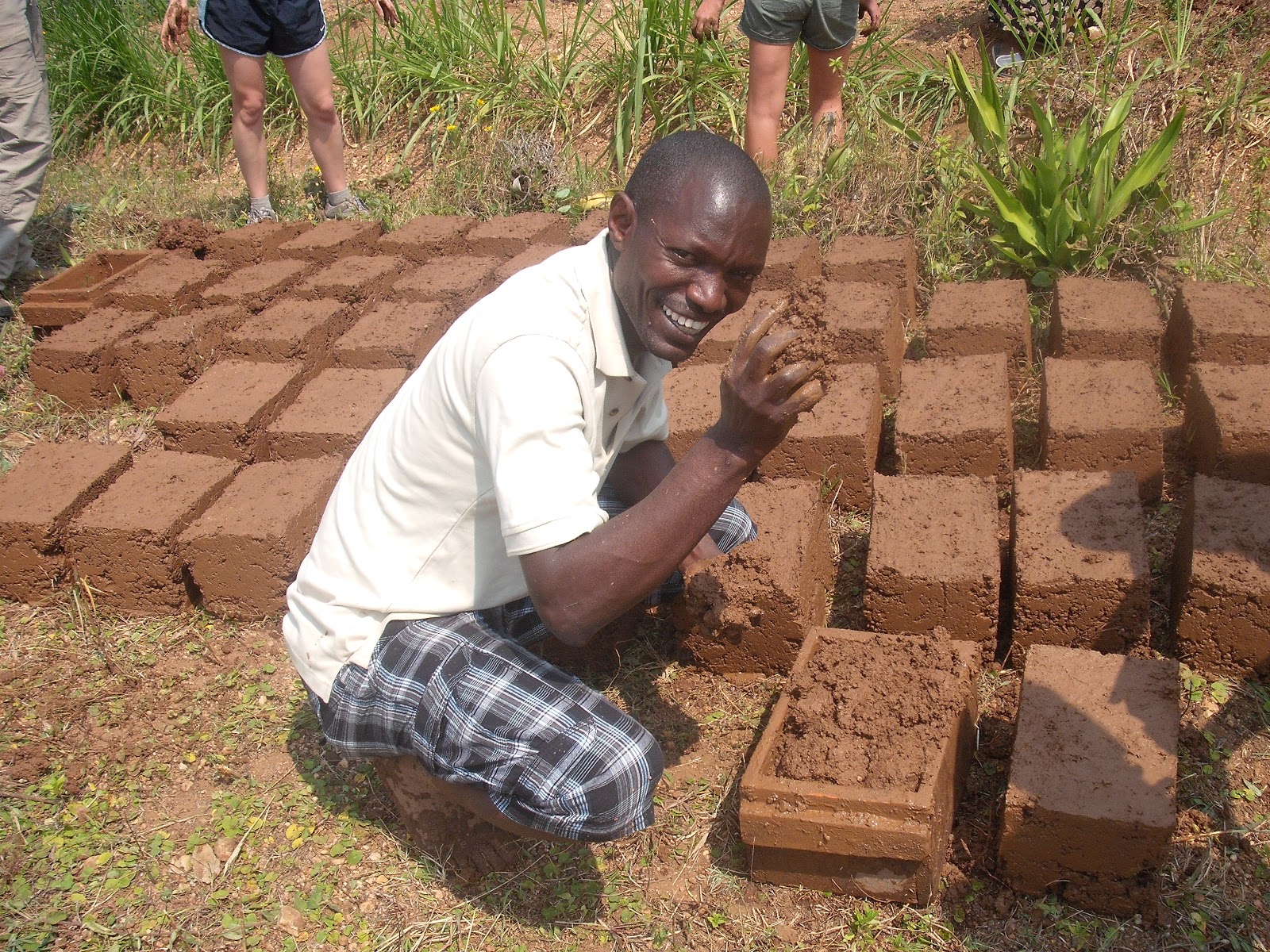
In a previous visit Brenda and a team of volunteers had helped to make bricks for one house, and now our team had the opportunity to do the same.

Brenda, One Person President and co-founder
Mary wrote about the brick making day in her blog on Planet Ranger:
"Today we hopped back on a bus to Muhanga and then walked down the side of a mountain to a house where we were invited to make mud bricks to help the family that needed them. Since we are volunteers we made around 150 bricks for free, the family was very thankful because when they pay someone to make the bricks it costs 25 RWF per brick. 150 bricks isn’t a lot, and when I roughly counted the bricks of the houses around us, I figured that we probably only made enough bricks for a quarter of a quarter of the walls. But helping the family save around 3750 RWF was a good feeling since they could now use that money to buy a goat or something else for the house.
The bricks are literally made out of dirt and water. They start by pouring water onto the dirt and then they use their feet to squish the water around, making the ground wet enough for them to throw it into a square mold for the bricks. The men making the mud held tools that looked like bent shovels to pound into the ground to break up the mud, roots, grass and rocks from each other. Then they rolled up the mud into a medium sized ball and passed it to the person next to them who then passed it to a few more people before it ended up into the concrete molds where Brenda and another man squished it around to make a perfect square brick with no air holes.
It was a great experience but I know that the people there were just doing it so we would be happy...and I know that they could have done it ten times faster than the silly mzungu’s did."

Evariste, the house owner, digs and prepares the mud. Brenda and One Person Director and co-founder Sheena work with Evariste and his family and neighbours.

Mary, One Person member and volunteer since our inception in 2007

Everyone helped to haul water! Luckily the stream was only a few hundred yards down the hill...
Evariste Nsengiyumva moved to Muhanga in 1996 from the then dangerous Congolese border. It took him eleven years to acquire his own land and he has finally saved enough money to begin building his family home.
We were joined after a while by Bart, founder of the U.S organization, Groundwork Opportunities and his team of volunteers, so we were able to get two lines of bricks going! Groundwork
Opportunities raised funds to help us get our Muhanga shipping container out of customs storage when it was held for far longer than expected.

Rendering the walls with a sand mixture
The house was about three quarters finished. Families pay to have bricks made and build as they go - sometimes it may take years to build a small house.

As usual - we had an audience. Erin shows the children their photograph.
Erin helped teach in out Train The Teachers week in Tanzania on this trip. Her school, Holy Cross, in Penticton, B.C. donated books to St. Timothy's school in Moshi, Tanzania in 2011 (Bart had asked One Person to make a donation there in return for their raising extra funds to help get the shipping container out of storage) so she travelled to St. Timothy's to meet the staff and children. Holy Cross is giving the school long-term support.
The house from the back

And the front

The government encourages people to not build the traditional small grass-thatched huts (Nyakasi) but to build larger homes with tin or tiled roofs.
 |
In 2006 (as a World Vision Volunteer) Brenda met this brother and sister who were orphaned after the genocide. They live in a remote area in a traditional grass hut. They told Brenda that in the rainy season, which lasts three months, they had to try and sleep standing up as the roof leaked and the dirt floor became a muddy pool.
It was very satisfying to take part in the brick making and work side by side with the villagers. Costa had been delayed returning from a trip so we were only at the village for part of a day, rather than the three days we had planned, so our contribution may not have made a massive difference to the progress of the walls in the house but by going back year after year and helping to build other houses in the community we are showing our commitment to our long-term involvement with Muhanga.

Subscribe to:
Posts (Atom)